Course-VIII-(A) (1.2.8A) Knowledge and Curriculum- Part-I
Topic outline
-
-
-
The 4 Pillars of Education
Education is at the heart of both personal and community development; its mission is to enable each of us, without exception, to develop all our talents to the full and to realize our creative potential, including responsibility for our own lives and achievement of personal aims. Jacques Delors (Delors, 1996).
A. LEARNING TO KNOW
Ø Implies learning how to learn by developing one's Concentration, Memory skills and Ability to Think.
Ø Involves the development of Knowledge and Skills that are needed to function in the world. These skills include Literacy, Numeracy and Critical Thinking.
Ø People have to learn to understand the world around them by combining a sufficiently broad general knowledge with the opportunity to work in depth on a small number of subjects. This also means learning to learn (autonomous learning), so as to benefit from the opportunities education provides throughout life. As a result of learning, the person is transformed that they are more Enlightened, more Empowered, more Enriched.
Ø Learning to Know helps individuals to:
1. Develop values and skills for respecting and searching for knowledge and wisdom.
2. Learn to learn.
3. Acquire a taste for learning throughout life.
4. Develop critical thinking.
5. Acquire tools for understanding the world.
6. Create a curious mind/learner.
7. Understand sustainability concepts and issues.
In summary: Learning to Know helps with the knowledge and information needed to work in a globalized, information society and knowledge economy. and the tools for learning how to learn and to independently acquire knowledge.
B. LEARNING TO DO
Learning to Do describes putting knowledge and learning into practice innovatively through:
(1) Skill development.
(2) Practical know-how.
(3) Development of life skills, competence, personal qualities, aptitudes, and attitudes.
Ø Involves the acquisition of skills that are often linked to occupational success, such as computer training, managerial training and apprenticeships.
Ø Identifies work-related values for technical and vocational education and training that contribute to the development of the whole person; the worker and the citizen with the knowledge, values, attitudes, behaviors and skills. needed to be able to participate fully and work effectively, ethically and responsibly, in a globalized world.
Ø In order to acquire not only an occupational skill, but also, more broadly, the competence to deal with many situations and work in teams. It also means learning to do in the context of young peoples various social and work experiences which may be informal, as a result of the local or national context, or formal, involving courses, alternating study and work. represents the skillful, creative and discerning application of knowledge, one must first learn how to learn effectively, how to think creatively, critically and holistically, and how to deeply understand the information that is presented, and its systemic implications for individuals and for society, in both the short and longer term.
C. LEARNING TO LIVE TOGETHER
Ø Learning to live together in peace and harmony is a dynamic, holistic and lifelong process through which (the shared values) are internalized and practiced. The process begins with the development of inner peace in the minds and hearts of individuals engaged in the search for truth, knowledge. and understanding.
Ø Involves the development of social skills and (1) values such as respect and (2) concern for others, social and (3) inter-personal skills and an appreciation of the diversity of the World.
Ø Discovery of other people:
1. Teach pupils and students about human diversity.
2. Instill in them an awareness of the similarities and interdependence of all people.
3. Children should be taught to understand other people's reactions by looking at things from their point of view.
4. Teaching the history of religions or customs can provide a useful reference tool for molding future behavior.
5. Recognition of the rights of other people should not be jeopardized by the way children and young people are taught.
6. Introduce young people to collaborative projects from an early age.
7. Involvement of teachers and pupils in common projects can help to teach a method for resolving conflicts and provide a valuable source of reference for pupils in later life.
8. Learning to live appropriately with others is important in our everyday lives - from life in the school, family and community to the special problems of adolescent relationships.
9. Learning to live together in the wider society requires awareness of and respect for human rights and the responsibilities of local, national and global citizenship.
10.Learning to live together as responsible citizens can help reduce tensions due to ethnic or other divisions and social disparities which contribute to the instability or civil conflict seen in many nations today.
D. LEARNING TO BE
· The all-round development of the whole person, to fulfill his/her highest potential, and be able to think, decide and act independently the source of creativity, innovation and entrepreneurship. The aim of development is the complete fulfillment of man, in all the richness of his personality, the complexity of his forms of expression and his various commitments as individual, member of a family and of a community, citizen and producer, inventor of techniques and creative dreamer.
· Involves activities that foster personal development (body, mind and spirit) and contribute to creativity, personal discovery and an appreciation of the inherent value provided by these pursuits.
· All people should receive in their childhood and youth an education that equips them to develop their own independent, critical way of thinking and judgment so that they can make up their own minds on the best courses of action in the different circumstances in their lives. In that connection, education must not disregard any aspect of a person's potential: memory, reasoning, aesthetic sense, physical capacities and communication skills.
· Learning to be' may therefore be interpreted in one way as learning to be human, through acquisition of knowledge, skills and values conducive to personality development in its intellectual, moral, cultural and physical dimensions.
AIMS OF EDUCATION
Individual aim of Education
ü Development as an individual of a human being.
✓ Moral & spiritual development.
✓ Cultural development.
ü Harmonious development.
ü Promote positive physical development.
ü Development of a right personality.
ü Development of good citizenship.
ü Development of good leadership.
ü Emotional & mental development.
ü Character building, etc.
The individual aim of education is to develop individuals according to their interests and capacities. The aim is to make people self- confident and self-dependent, so they can make decisions and solve problems on their own.
Here are some merits of the individual aim of education:
* It helps people develop their potential.
* It helps people realize their rights and perform their duties properly.
* It helps people perfect themselves.
Here are some demerits of the individual aim of education:
* It can make people selfish and self- centered.
* It can ignore the impact of socio-cultural environment on the development of individuality.
* It can lead to the development of classes in society and nation.
* It can lead to more political exploitation.
* It can lead to unequal distribution of resources based on income and wealth.
The social aim of education takes into consideration the social needs of society. In other words, when a society wants to have a very strong social organization and does not permit freedom to the individual members to deviate from its social traditions, it emphasizes to a great extent the social aim of education.
Merits of Social Aim of Education:
1. Conformity to social norms and values.
2. Understanding social rights.
3. Promotion of social values.
4. Promotion of the concept of unity of human race.
5. Development of political insight.
Demerits of Social Aim of Education:
1. Conformity to only set values and norms.
2. Creation of classes.
3. Political exploitation.
AGENCIES OF EDUCATION - MEANING AND CLASSIFICATION
As a teacher, you might understand that education is a life-long process. It starts from the birth of the child and continues till the death. During the entire period of one's living, the human being comes in contact with various situations, institutions, and organizations. They get themselves educated through different agencies of education. The agencies of education can be clarified as the sources for getting information, knowledge, and education like the Family, School, Community, Media etc. According to Bhatia (1994), 'Society has developed a number of specialized institutions to carry out the functions of education. These institutions are known as Agencies of Education. Among the agencies, some may be the formal agencies of education whereas others informal agencies. In this section, we will discuss the classification of the agencies of education.
Classification of Agencies of Education
As prescribed by Brown (1947), quoted from Saxena (2009), classification of the agencies of education can be done in various ways. Let us discuss some of the important classifications of the agencies and in the next section of this Unit, we will discuss the functions of the agencies of education.
FAMILY AS AN AGENCY OF EDUCATION
Psychologically and physically the first contact and interaction the child makes with the outer world is with his/her mother. Learning process of the child begins the moment she/he is born. His/her brain takes shape in accordance to the responses made to the stimulus. The child's brain is nascent, eager to record the first reaction of the person who comes in contact with him/her. The home environment gives shape to his/her psychological and sociological growth. Mother becomes the first teacher. Undoubtedly, that is the reason that the first language a child learns is called "mother tongue". When we use the term "Home", it signifies the place where there are parents and other family members who the child comes in contact with, where the child is loved, cared for, disciplined, reared, taught and brought up, where a responsibility is felt by the family to modulate the child and attend his/her needs. Home, therefore, plays a very important role in laying the foundation of the child's personality in terms of physical, emotional, social, moral and cognitive aspects.
Functions of Home in Changing Scenario of Family
As change is a continuous process, you might have observed changes in family system, in terms of deteriorating joint family system and also, size of the family. In joint families, there are the family members who are emotionally attached with each other and play an active role in the upbringing of the development of the child. The following are the major educational functions of the family which works for developing the all-round personality of the child:
1. It educates the child about the attitude, moral and values, ethics, skills, behavior pattern at the family as well as the society.
2. It teaches the child about the culture, tradition, and customs of the society and also, teaches fellow feeling, love and belongingness in living together.
3. It helps in developing physical, mental, and emotional development of the child.
4. It influences the socialization and actualization of the child.
5. It identifies the interest and motivation of the child and accordingly provides opportunities to them.
6. Home also helps the child in bringing closeness of home and school.
7. Home not only provides basic necessities of the child, it also equally provides many opportunities to the child for future living.
8. It helps the child for developing a balanced personality in all aspects of human living.
Agency for the Development of the Child
Family brings the following developments among the child:
* Physical Development : The child spends his/her infancy within the family. The priority, initially, should be on the physical growth of the child. The family should take care of the diet of the child and ensure that the child is nourished.
* Social Development : The first step towards socializing is learnt by the child is the love and affection receives from his/her family. Home is the first social institution that attempts to socialize the child. The social development of the child depends upon the love, affection, recognition, security, approval, freedom etc. the child receives from the family. The child receives approval for righteous conduct from parents. The child also observes parents day to day activities and it impinges upon behaviour of the child. The manner in which the family conducts itself channelizes future role and performance of the child.
Emotional Development : The behavior of the parents defines the emotional development of the child. Needless to say, the child first develops emotional bonding with the parents. The feeling of 'acceptance", 'love and belongingness' and 'togetherness comes from the family only, which provides emotional maturity to the child.
* Mental Development : Like the physical growth, mental development of the child also goes on simultaneously. From the very beginning of infancy, child learns to understand others, recognise signs and symbols, speech and imitate others. This is the family that educates the child, not through formal process but informally by action, play, and stories.
* Moral & religious development : The parents become the first role model for the child. It is widely seen that a girl child copies her mother and so does the boy of his father. The reinforcement that comes as a response to the child's behavior creates the value system. The reinforcement that a child receives from his/her parents towards a particular act makes the child differentiate between the right and the wrong. The immoral acts of the child should be checked by the parents at the very initial stage. The value system of the child depends on the morals and religious activities practiced within the family.
Apart from these, the family has further responsibility to make the child develop a sense of nationalism towards their Country, to understand their duties and responsibilities to the society, to respect human life and dignity, and to preserve family values and culture.
SCHOOL AS AN AGENCY OF EDUCATION
School in the modern time is indispensible and has become an important formal agency of education. It delivers to the ever changing demand for education and need of the contemporary world.
The word "School' has been derived from the Greek word 'Skhole" that means leisure. It was before in the ancient Greece to utilize leisure time in a systematic way. In Ancient times, India had the Gurukula system of education where students were accepted as Shishayas and stayed with the guru in ashrams gurukuls. This made the guru understand the psychology of the child and impart entire knowledge available including moral education, language, religious books, Philosophy, Mathematics, metaphysics etc. The learning was confined to understand life, nature or imparting values. It did not require only memorizing the information. But now the concept of schooling has change, it denotes a formal center of education where the children need to be taught about the system, governance, civic structure. democracy, Country, demography, History, Languages, vocations etc. The School system, thus, became an important agency for imparting knowledge. It also brings uniformity in education to the society.
Functions of School in Changing Scenario of Education
The School is an agency of education and also as a miniature of the society. It comprises the stakeholders of teachers, students, parents and also the Govt, education administrations, The Schools have its own culture and own social setting. Socialization and acculturation are also important functions of the School. The School, as a miniature of the society, works for socializing the young generation. Socialization refers to a process by which children acquire personal identities and learn knowledge, language, and social skills required to interact with others. Again, students not only learn from the academic curriculum prepared by teachers and School administrators, they also lean social rules and expectations from interactions with others.
Besides socialization, another significant manifest function of School is the transmission of cultural norms and values to new generations, which is known as acculturation. Schools help mold a diverse population into one society with a shared national identity and prepare future generations for their citizenship roles. Students coming from different strata of the society are made to follow the rules and regulations of the School. School undertakes different activities at different levels to ensure overall personality development of the child. School therefore plays a significant role in laying the foundation of child's personality in terms of physical, cognitive, social, emotional and moral development. In the changing scenario of education, the School basically performs two types of functions: (a) Manifest functions and (b) Emerging functions
(a) Manifest Functions:
Transmitting Traditional Culture:
The School is an agency, transmits culture, the process by which the culture of a society is passed on to its citizens. Individuals are also taught about culture acquire knowledge, beliefs, values, and norms. School helps the children to develop self-concepts, emotions, attitudes and behaviour. Every society has its own heritage and history. The main function of the School is to make the students aware about the culture. This is done through formal teaching of History, Literature etc.
Teaching Basic Skills and Vocational Education:
The School responds to society's need and complies with society's demands for preparing trained workers, intellectual and well-educated citizens. The School is expected to train the individual for occupational and vocational skills. In this way, the abilities and interests of an individual are identified and are fine tuned. They become more committed in this way and competencies and skills are used to its full potential. Presently, Govt. of India focusing more on skill based education starting from school stage. This should be the main focus of the school to produce skill human power.
Character Education:
The School is expected to imbibe values in the children. In school curriculum, moral science is taught as a subject. The stories of national heroes are also part of the curriculum. The School has a responsibility to create individuals of high morals and character. In School, students learn to follow rules and regulations; they learn patience, to respect other beliefs and thoughts; and also teach to make the learners to follow ethics, values, morals, and life skills education. The above aspects which are taught by the schools lead to character development of the child.
(b) Emerging Functions:
Life Skills Education:
Today's society also expects the School to teach students life skills such as self-awareness, effective communication, creative thinking, critical thinking. problem solving ability, coping with stress, coping with emotions etc. According to World Health Organization- life skills are the abilities for adaptive and positive behavior that enable individual to deal effectively with the demands and everyday challenges.
Increased Functional Literacy :
School certainly acts as a transmitter of knowledge and academic skills like reading, writing and arithmetic. To a layman, literacy means knowledge of 3R (Reading, Writing and Arithmetic). Functional literacy implies knowledge, skills, attitudes and values by acquiring which the individual can perform effectively in living in the society. It is not only restricted to achieve a particular percentage of literacy rates.
Diffusion of New Knowledge:
School also sets a stage for developing the minds of the children. It encourages children to give air to their ideas. It promotes creative thinking among the youth. There are activities in the school where the children have to make projects. Scientific exhibitions are held where children make prototypes based on scientific principles. The knowledge is not limited to the curriculum. Active teachers promote diffusion of new knowledge and adopt innovative techniques. The School creates a rearing ground for fresh minds, novel ideas, innovative thinking, scientific observation and inquiry, etc.
Sex and Family Education:
In India, parents hesitate to discuss sex education. This duty was again casted on to the school to provide sex and family education. It was included as part of the curriculum. It dispels various misconceptions about sex and family education. It lets the children know about the biological developmental process of body and creates healthy atmosphere to live.
Learning to live together:
According to Delors Commission (1996), 'the task of education is to teach at one and the same time, the diversity of human race and an awareness of the similarities between and the interdependence of all humans. From early childhood, schools must therefore take every opportunity to teach two things. The School actually allows children to mingle and interact. The student is made to adopt the point of view of other ethnic or religious groups and develop an attitude of acceptance to other feelings and beliefs. The School promotes religious harmony. The children learn to co-exist with other groups. It helps the students to develop a receptive mind.
COMMUNITY AS AN AGENCY OF EDUCATION
The term community has been derived from two distinct words "com" and" Munis", 'com' means togetherness and 'munis' means to serve. Thus the term community means "to serve together". A group of people having commonality in way of living, principles and ideals is called a community. Community can be divided on the basis of
i) Population i.e. village or town. ii) Language. iii) Religion. iv) Social composition. and v) Economic conditions.
Functions of the Community in the Changing Scenario of the Society
Community is an informal agency of Education. Community is a larger social unit as compared to family. We have already studied that socialization, awareness about culture, development of the we feeling and providing moral and religious educations are main functions of family. Community is RSITY the part of larger society and family is the part of community. Socialization and acculturation are the main functions of the community. By attending many community functions like marriage, festivals etc., children get to know about the value system and social culture. Through community, child imbibes customs and traditions which regulate their social behavior.
Educational Functions of the Community:
As discussed, socialization and acculturation are the main functions of the community. School is also a part of community. The community also realizes the resources and opportunities available and responds accordingly. The community plays an active role by interacting with the School and improving its quality. Community makes all efforts for the all-round development of the children. It also establishes hospitals, parks, and playgrounds for the physical development of the child. Community also takes the responsibility to open Cinema, Zoo, Libraries, etc. which influences the life and activities of the children. Every community has its heroes, who have set an example and who the society wants its future generations to emulate, which helps the children set up their value system. According to the Delors Commission
Philosophical Perspectives of Education
According to the Delors Commission (1966), the main parties contributing to the success of educational reforms. are first of all the local community including the parents, the school heads and teachers. It is obvious that local community plays a paramount role in any successful reform strategy. The community focuses on the utility value of education; ultimately they want the students to be able citizens and also to add to the productivity of the nation and earn as well.
MEDIA AS AN AGENCY OF EDUCATION
With advancement in the field of educational technology, media is being used for the purpose of formal or informal education. We are living in the age of science and technology. Mass media can improve the quality of education as it enables interactive communication with large number of people. Mass media may be defined as the medium or agency through which ideas, attitudes or impressions are communicated to a large number of people.
John Dewey has stated that education cannot be limited to the teacher or taught without social environment. So, mass media is one such potent force to create asocial environment for education. Through modern electronic techniques and technologies, mass media has proven that education is really comprehensive but not confined within four walls of the classroom. Mass media is a medium for the masses and it imparts knowledge without any limitations. It does not even know the boundaries of country and makes the entire world a family. Great deal of information is available in this medium in the form of newspaper, TV, radio, magazines, journals, films, internet, world wide web, social media, etc. Mass media has become a reservoir of knowledge flowing around the world today and has penetrated into every activity of daily life. It has become indispensible and is hard to imagine without media technology. It is gaining importance every day.
Functions of Media in the Changing Scenario
Philosophical Perspectives of Education
Like family, school and home, media also plays a vital role in socialization and acculturation. Media contributes in formal, informal and non-formal education of the children. It facilitates in spreading ideas, thoughts, beliefs, etc. in people of all ages. The information is disseminated through TV, Radio, Magazines, News Papers, Journals etc. This is being supplemented by Information and Communication Technology. ICT is an important tool for bridging social divides. ICT is making information and knowledge flow to remote areas and bringing them to the mainstream. The media has made enormous possibilities of sharing and gaining information and ideas. ICT has not only made our education system easy but also has equally influenced the administrative system of public policies and governance.
The rapid progress of information technology is offering new prospects for development by opening up isolated places or regions and enabling persons to communicate with the whole world in the field of specific research. It provides easy access to international database and permits the establishment of virtual laboratory.
Educational Functions of the Media:
Media is one of the means of educating the society. It is one of the cheapest and quickest means of education. Media is also now an important tool in the hands of the teacher. It is now actively used in the classrooms in the form of use of multi-media packages, social media, individual and group learning and assessment. Success of education cannot be achieved merely by substituting mechanical methods for human beings, but by developing new patterns using both human beings and technological advancements in order to teach people in a better way. Information technology is undoubtedly providing knowledge, skills, improving understanding and changing attitudes.
Media is being used both as formal and non-formal system of education. Educational media has gained significance, both at individual and mass level of learning. Information Communication Technology is especially used for non-formal education like in ODL system. In India, IGNOU and NIOS like institution are providing educational programme throughout the country through Radio, Television, and online programmes. The Central Institute of Educational Technology under the NCERT is mainly concerned with the development of innovations and with using various media in School education. It is engaged in the development of an attractive system of education using television through INSAT to reach in and out of school children and teachers in rural areas. It produces E.T.V. programmes and these programmes are being telecast via INSAT. The Electronic Media Production Center in IGNOU is also contributing in developing audio-video materials, direct telecast through Teleconferencing and Interactive Radio Counselling for the learners.
The Delors Commission , also observes that new technology has created a host of new tools to use in the classroom as under:
1. Computer & Internet
2. Cable and satellite TV education
3. Multimedia equipments
4. Inter-active information exchange system including e-mail and online access to libraries and public data base.
NPE, 1986, has been emphasized as, 'modern communication techniques have the potential to bypass several stages and sequences in the process of development encountered in earlier decades. Both the constraints of time and distance become manageable. In order to avoid structural dualism, modern educational technology must reach out to most distant areas and most deprived sections of beneficiaries. The National Knowledge Commission in its report also recommended online learning and use of varieties of media in the process of teaching and learning. Most importantly, the progress of MOOCS throughout the world and the present initiation of the Govt. of India for "Digital Literacy' campaign work as great motivation for multimedia use in education.
The multimedia system has made possible personalized learning which any individual can choose. Online interactive programmes are available on the net which enable the individual to take course through non-formal education. Informal education through media has made it possible for every individual in far off places to have education. Learning materials are also available online. No longer are the students solely dependent on the classrooms and teachers. The students have an option to expand their learning by not limiting themselves to the classroom. This medium has also been a great help to the underachievers.
According to NCF 2005, 'mass media can be used to support teacher training. facilitate classroom learning and be used for advocacy. Possibilities of teaching and learning at varied paces, self-learning, dual modes of studies, etc. could all benefit from the use of technology particularly ICT. The increasing use of internet has enabled the sharing of information and provided space for debate and dialogue on diverse issues. Technology is also enabling students with special needs the use of equipment's and aids.
With the advent of media, no doubt the teachers are also going through a transition. The teachers ought to be aware and equipped with these tools. The teachers will have to be a breast with the latest development, trend, thoughts, ideas and researches.
Different types of education: Formal, Informal and Non- formal.
Education goes beyond what takes places within the four walls of the classroom. A child gets the education from his experiences outside the school as well as from those within on the basis of these factors. There are three main types of education, namely, Formal, Informal and Non- formal. Each of these types is discussed below.
Formal Education
Formal education or formal learning usually takes place in the premises of the school, where a person may learn basic, academic, or trade skills. Small children often attend a nursery or kindergarten but often formal education begins in elementary school and continues with secondary school.
Post-secondary education (or higher education) is usually at a college or university which may grant an academic degree. It is associated with a specific or stage and is provided under a certain set of rules and regulations.
The formal education is given by specially qualified teachers they are supposed to be efficient in the art of instruction. It also observes strict discipline. The student and the teacher both are aware of the facts and engage themselves in the process of education.
Examples of Formal Education
*Learning in a classroom
* School grading/certification, college, and university degrees
* Planned education of different subjects having a proper syllabus acquired by attending the institution.
Characteristics of formal education
· Formal education is structured hierarchically.
· It is planned and deliberate.
· Scheduled fees are paid regularly.
· It has a chronological grading system.
· It has a syllabus and subject- oriented. The syllabus has to be covered within a specific time period.
· The child is taught by the teachers.
Advantages of Formal education:
* An organized educational model and up to date course contents.
* Students acquire knowledge from trained and professional teachers.
* Structured and systematic learning process.
*Intermediate and final assessments are ensured to advance students to the next learning phase.
* Institutions are managerially and physically organized.
* Leads to a formally recognized certificate.
* Easy access to jobs.
Disadvantages of Formal education:
* Sometimes, brilliant students are bored due to the long wait for the expiry of the academic session to promote to the next stage
* Chance of bad habits' adoption may be alarming due to the presence of both good and bad students in the classroom
* Wastage of time as some lazy students may fail to learn properly in spite of motivation by the professional trainers.
* Some unprofessional and non-standard education system may cause the wastage of time and money of the students which leads to the disappointment from formal education and argue them to go for non-formal education.
Informal Education
Informal education may be a parent teaching a child how to prepare a meal or ride a bicycle.
People can also get an informal education by reading many books from a library or educational websites.
Informal education is when you are not studying in a school and do not use any particular learning method. In this type of education, conscious efforts are not involved. It is neither pre-planned nor deliberate. It may be learned at some marketplace, hotel or at home.
Unlike formal education, informal education is not imparted by an institution such as school or college. Informal education is not given according to any fixed timetable. There is no set curriculum required. Informal education consists of experiences and actually living in the family or community. Given according to any fixed timetable. There is no set curriculum required. Informal education consists of experiences and actually living in the family or community.
Examples of Informal Education
* Teaching the child some basics such as numeric characters.
* Someone learning his/her mother tongue
* A spontaneous type of learning, "if a person standing in a bank learns about opening and maintaining the account at the bank from someone."
Characteristics of Informal Education
* It is independent of boundary walls.
* It has no definite syllabus.
* It is not pre-planned and has no timetable.
* No fees are required as we get informal education through daily experience and by learning new things.
*It is a lifelong process in a natural way.
* The certificates/degrees are not involved and one has no stress for learning the new things.
* You can get from any source such as media, life experiences, friends, family etc.
Advantages of Informal Education
* More naturally learning process as you can learn at anywhere and at any time from your daily experience.
*It involves activities like individual and personal research on a topic of interest for themselves by utilizing books, libraries, social media, internet or getting assistance from informal trainers.
* Utilizes a variety of techniques.
* No specific time span.
* Less costly and time-efficient learning process.
* No need to hire experts as most of the professionals may be willing to share their precious knowledge with students/public through social media and the internet.
*Learners can be picked up the requisite information from books, TV, radio or conversations with their friends/family members.
Disadvantages of Informal Education
* Information acquired from the internet, social media, TV, radio or conversations with friends/family members may lead to the disinformation.
* Utilized techniques may not be appropriate.
* No proper schedule/time span.
* Unpredictable results which simply the wastage of time.
*Lack of confidence in the learner.
* Absence of discipline, attitude and good habits.
Non-formal Education
Non-formal education includes adult basic education, adult literacy education or school equivalency preparation.
In nonformal education, someone (who is not in school) can learn literacy, other basic skills or job skills.
Home education, individualized instruction (such as programmed learning), distance learning and computer-assisted instruction are other possibilities
Non-formal education is imparted consciously and deliberately and systematically implemented. It should be organized for a homogeneous group. Non-formal, education should be programmed to serve the needs of the identified group. This will necessitate flexibility in the design of the curriculum and the scheme of evaluation.
Examples of Non-formal Education
* Boy Scouts and Girls Guides develop some sports program such as swimming comes under nonformal education.
* Fitness programs.
* Community-based adult education courses.
* Free courses for adult education developed by some organization.
Characteristics of Non-formal Education
* The nonformal education is planned and takes place apart from the school system.
* The timetable and syllabus can be adjustable.
* Unlike theoretical formal education, it is practical and vocational education.
*Nonformal education has no age limit.
* Fees or certificates may or may not be necessary.
*It may be full time or part- time learning and one can earn and learn together.
*It involves learning of professional skills.
Advantages of Non-formal Education
*Practiced and vocational training.
* Naturally growing minds that do not wait for the system to amend.
* Literacy with skillfulness growth in which self-learning is appreciated.
* Flexibility in age, curriculum and time.
* Open-ended educational system in which both the public and private sector are involved in the process.
* No need to conduct regular exams.
* Diploma, certificates, and award are not essential to be awarded.
Disadvantages of Non-formal Education
* Attendance of participants is unsteady.
*Sometimes it's just wastage of time as there is no need to conduct the exam on regular basis and no degree/diploma is awarded at the end of the training session.
* Basic reading and writing skills are crucial to learn.
* No professional and trained teachers.
* Students may not enjoy full confidence as the regular students enjoy.
* Some institutes provide fake certification through online courses just for the sake of earning.
The Distance Education System
Although distance learning is not a completely new thing for us, recently it has taken the world by storm. The recent pandemic situation has brought it into the spotlight because of how useful and convenient it has been for us.
Distance learning is a form of education that doesn't require students to be physically present in school. This form of education conducts classes in the form of videos and modules, even exams are conducted online. As a result, you are able to participate from anywhere in the world.
Regular Education System
The traditional education system has remained quite the same. Universities are still operating face-to-face classes. Although the use of multimedia and technology has changed the experience around the last few decades, students who are pursuing
degrees are still attending lectures and examinations to finish courses.
Distance Education Vs. Regular Education
Education gives us knowledge of the world around us. It builds our capacity to change it into something better. So, if there were anything that you would like to get conveniently, it would be education. The flexibility in learning is comparatively a newer concept.
In the past, people would often select a profession for themselves and carry it out for the rest of their lives to make their livelihood, but people are having to adapt to new situations-even working two jobs at the same time. The changing times will require people to develop more and more new skills to adapt to socio-economic changes. People are going to have to keep adding to their set of skills. It's not going to just be about their bachelor's degree.
People are having to adapt to new things and learn new skills. This is a part of the whole new upgrade we are going through in all walks people are having to adapt to new things and learn new skills. This is a part of the whole new upgrade we are going through in all walks of life. The world is not the same as how the traditional academics shaped it. People are having to adapt to new skills and learn new things to keep up with the modern world. It has particularly changed a lot in the way we interact with people and how we learn new things.
DISTANCE EDUCATION (OPEN AND DISTANCE LEARNING)
Today two terms that are being used almost inter-changeably are 'Open Learning' and 'Distance Education' and they are often combined to be known as Open and Distance Learning (ODL). Open learning is a philosophy and Distance Education is the mode used for translating it into reality as the two are complementary to each other.
It is an umbrella term which describes all the teaching-learning arrangements in which the learner and the teacher are separated by space and time. In fact, it is a mode of delivering education and instruction to learners who are not physically present in a traditional setting of classroom. Transaction of the curriculum is effected by means of …
audio/videotapes, Internet and World Wide Web, etc. Also, a technological medium replaces the inter-personal communication of conventional classroom-based education that takes place between the teacher and the learners. Communication between the institution, teacher, and learners is mainly through electronic media (telephone, chat sessions, email, website, etc) and also through postal correspondence and limited face to face contact sessions held at Study Centres that are set up by the DE institutions as close to the learners' homes as possible
OPEN LEARNING
Open learning, which covers a wide range of innovations and reforms in the educational sector that advocates flexibility to the learner with regard to entry and exit; pace and place of study;
method of study and also the choice and combination of courses; assessment and course completion. The lesser the restrictions, the higher the degree of openness. The Open learning system aims to redress social or educational inequality and to offer opportunities not provided by conventional universities. opportunities colleges or Educational are planned deliberately so that access to education is available to larger sections of society. Thus, ODL is a term that accepts the philosophy of "openness" and uses "distance mode" of learning .
WHY ?
ODL occupies a special place in the Indian higher education system because of its major contribution in enhancing the gross enrollment ratio and democratization of higher education to large segments of the Indian population particularly to reach out to the unreached and to meet the demands of lifelong learning which has become more of a necessity in the knowledge society. The major objectives of the DE system are:
* To democratize higher education to large segments of the population, in particular, the disadvantaged
* Groups such as those living in remote and rural areas, working people, women, etc. To provide an innovative system of university-level education which is both flexible and open in
* Terms of methods and pace of learning; a combination of courses, eligibility for enrollment, age of entry, the conduct of examination and implementation .
* Terms of methods and pace of learning; a combination of courses, eligibility for еnrollmеnt, age of entry, the conduct of examination and implementation of the programs of study; To provide an opportunity for up- gradation of skills and qualifications.
* To develop education as a lifelong activity to enable persons to update their knowledge or acquire knowledge in new areas.
What is the difference between online and blended learning?
The online learning environment relies on computers connected to the internet. Responsibility for learning shifts primarily to the learners. To this end, the teacher's role is to guide learners, using a variety of online strategies, while providing them with clear instructions to assignments or tasks that compliment and ultimately accomplish the established course learning objectives tasks that compliment and ultimately accomplish the established course learning objectives.
In an online course, there is 100% online course delivery with little or no face-to-face sessions. By contrast, blended learning is a mix of face-to-face teaching and the online approach. Students in such a course not only have the convenience of learning and revising at their individual pace but each student has the benefit of interacting in face-to-face sessions. Blended learning, therefore, provides the best of both worlds for students and lecturers alike as participants are granted the hands-on experience of the face-to-face class as well as the convenience and flexibility of the online environment.
-
-
-
Definitions and Characteristics of Curriculum
Ø Meaning of Curriculum
A curriculum is a planned course of study. It is an outline of what should be taught and learned in an educational institution such as a school, or college. It is used to organise and teach a particular course.
Ø Concept of Curriculum:
· Etymologically, the term curriculum is derived from the Latin word “currere” which means “run”. Thus curriculum means a course which one runs to reach a goal or destination. In this sense, education is considered as a race, with its aim as the goal, and curriculum as the course, leading to that goal. It is sometimes called a course of study.
· It describes the ground which pupil and teacher cover to reach the goal or objective of education. So the term ‘curriculum’ refers to a group of subjects or courses of study arranged in a particular sequence, for instructional purposes in schools.
● Definition of Curriculum
The term curriculum has been defined by different writers in different ways:
· 1. Cunningham – “Curriculum is a tool in the hands of the artist (teacher) to mould his material (pupils) according to his ideas (aims and objectives) in his studio (school)”.
· 2. Morroe – “Curriculum includes all those activities which are utilized by the school to attain the aims of education.
· 3. Froebel – “Curriculum should be conceived as an epitome of the rounded whole of the knowledge and experience of the human race.”
· 4. Crow and Crow – The curriculum includes all the learners’ experience in or outside school that are included in a programme which has been devised to help him developmentally, emotionally, socially, spiritually and morally”.
· 5. T.P. Nunn-“The curriculum should be viewed as various forms of activities that are grand expressions of human sprit and that are of the greatest and most permanent significance to the wide world”
· The Secondary education commission (1952-53) says:
Curriculum does not mean only the academic subjects traditionally taught in the school, but includes the totality of experiences that pupil receives through the manifold activities that go on in the classroom, library, laboratory, workshop, playground and in the numerous informal contacts between teachers and pupils.
It is more than text books, subject matter and the courses of study. Curriculum, in fact, is a means with which children adjust themselves to their environment. The acknowledgement of the fact that experience is the best teacher, has given a new approach to curriculum.
According to Kerr, "Curriculum is all the learning which is planned and guided by the school, whether it is carried on in groups or individually, inside or outside of school"
According to Good, "Curriculum is a general over- all plan of the content or specific materials of instruction that the school should offer the student by way of qualifying him for graduation or certification or for entrance into a professional or vocational field".
● Characteristics of Curriculum
Let's discuss some points which cover the characteristics/features of curriculum. These are as follows -:
1. Meet the needs of students :
Educational experts design the curriculum keeping children in mind. What is the benefit of the curriculum if it fails to meet the needs of children? Therefore it should be designed according to the needs of children so that they can get maximum benefits from it.
2. Flexible and adaptive :
Curriculum should be flexible. It should not be rigid, otherwise it will create problems in its adaptation. Irrelevant material and content should not be a part of it; otherwise, we can't call it a good curriculum. Stakeholders such as teachers, parents, or headmasters can play an important role to maintain the flexibility of curriculum.
.
3. Well organised :
Curriculum should be well organised. The content of curriculum should be organised in such a way that it connects students' prior knowledge with the new knowledge. There should be a proper link between theory and practical knowledge. All the subjects or topics should have clearly defined objectives.
4. Provide opportunities for students :
A good curriculum provides enough opportunities for students to explore their talent and creativity. The all-round development of children takes place when they are exposed to new challenging environment.
Appropriate activities should be included in the curriculum to fulfill the Special learning needs of gifted, backward, and disabled learners.
5. Motivate students :
Curriculum as a tool motivates students to learn more and perform various activities. It motivates students by making the process of learning more enjoyable and interesting. It helps students focus more on their mastery goals.
6. Follow pedagogical approach :
Curriculum follows a pedagogical approach. Various pedagogical approaches such as Activity-based learning, Team teaching, inquiry-based learning, Cooperative and collaborative learning are used by teachers to teach students. These approaches help teachers choose desirable instructional strategies.
7. Demands of society :
Society plays an important role in determining what is relevant for the students.. Therefore, curriculum should reflect the needs and demands of society.
Those subjects should be included in the curriculum which provide value to society and appreciate its cultural heritage.
8. Extend skills and knowledge :
A good curriculum extends students' skills and knowledge by
› Promoting higher order thinking skills
› Developing curiosity
› Removing their misconceptions
9. Quality and Up-to-date content :
Curriculum should provide quality and up-to- date content to students which reflect their personal interests. Content should be properly analysed and research based. There must be scope for adding new and relevant information to the curriculum.
10. Should be diversified :
A uniform curriculum will not work in today's education system. Therefore, curriculum should be diversified. Diversified curriculum provides a wide range of opportunities to students, especially those from backward class, and prepares them for the future.
Some other characteristics:
11. It should be designed by keeping in mind the aims and objectives of education.
12. It should follow psychological principles.
13. It should promote the interaction between teachers and students.
14. It should promote integrated learning.
· Principles of Curriculum construction
● Principle of Curriculum Construction:
The content of curriculum is determined on the basis of some academic principles which are stated below:
(1) Aims of education and objectivity:
In farming the curriculum one should take into consideration the aims and objectives of education.
(2) Child-centric principle:
The curriculum should be framed according to the actual needs, interests and capacities of the child. That means a curriculum must be child-centric.
(3) Principles of civic and social needs:
Man as a social being lives in the society. The child develops in the society. Modern education aims at both developments of the individuality of the child as well as the development of the society.
(4) Principle of conservation:
Man has conserved experiences very carefully for better adaptability. Education is regarded as a means of deserving the cultural heritage of humanity. The school serves two-fold functions in this regard- preservation of the past experiences and transmission of experiences.
(5) Principles of creativeness:
Education not only conserves that past experiences of humanity but also helps an individual to develop his innate potentialities.
(6) Principle of forward-looking:
Education must prepare the child of shouldering future responsibilities. So in farming the curriculum we must take into consideration the future needs of the child as well as the needs of the society.
(7) Principle of preparation for living:
The children should know the various activities of the environment around them and how these activities are enabling people to meet their basic needs of food, shelter, clothing, recreation, health and education.
(8) Principle of integration and correlation:
Subjects should be arranged logically and psychologically in accordance with the child’s developing interests.
(9) Principle of learning ability:
Every item should be learnt. An item should not only be learnable, it should also have utility.
(10) Principle of individual difference:
The curriculum should be framed in such a way that every individual can have opportunity for self-expression and development. The curriculum should be based on the psychology of individual difference, which can meet the complexities of modern democratic society.
(11) Principle of social relevancy and utility:
Subjects should not be determined on the basis of their disciplinary value but on the basis of their intrinsic value, social relevancy and utility.
(12) Principle for utilization of leisure:
Variety of subjects such as games and sports, fine arts, subjects of aesthetic value are to be introduced in the school programme to utilize leisure.
(13) Principle of variety and flexibility:
The curriculum should include such activities and experiences, which may facilitate his normal development. The curriculum for girls should naturally be different from that of boys; boys and girls have different needs and attitudes.
(14) Principle of time:
Relative significance and importance of each subject in the curriculum has to be judged and determined in the light of the time available in the timetable, which is regarded as the mirror of the school programme.
Ø Modern trends in curriculum construction:
1) Digital Diversity
It emphasis on ICT technology. Example, Khan academy.org also provides good videos, lectures and many more which makes learning meaningful, easy and effective. Curricki merlot, K2-12 Hippocamus all these provides educational resources which students can use, edit reconstruct and so on.
2) Need based Curriculums
Need based curriculum is the foremost need of the present education system. Many universities are developing need based short term programs for this purpose. E.g. Mumbai University has introduced courses like – certificate course in PowerPoint, certificate course in tally, certificate course in marketing, YCMOU- introduced –English communication skills program for Mumbai Dabawala.
3) Modular Curriculum with credit base system
Modular curriculum gives real freedom of learning .especially in the open learning system his approach has been adopted at first but now majority of traditional universities also accepting his system; this is a real emerging trend in the modern curriculum.
4) Online coerces
Need based and choice based curriculums are available online also. E.g. course era .com has introduced many useful need based courses for free of cost. Government also takes initiative for this e.g. Right to Information certificate curse has been introduced by Government of India to the Indian people. This course is free and online.
5) 21st century skills
All the curriculums of various courses should focus on 21st century skills. Skills like collaboration, critical thinking, effective communication, multitasking stress management, empathy are must for all the personals.
6) International Understanding
Globalization has made converted the world in to global village. We should consider world as a one family and for this international understanding must be inculcate through curriculum.
7) Constructivism
Constructivist approach believes that learner should be given freedom to construct his/her knowledge. Spoon feeding must be avoided. If a learner is fully active in construction of knowledge then learning process will be highly effective. In all the curriculums constructivist strategies must be given important place.
· Types of Curriculum
1. Child-Centered Curriculum
It is also called learner-centered curriculum. The philosophy underlying this curriculum is that the children is that the center of the educational process. This pattern of curriculum bases upon the abilities and the interest of the learners and students have experiences and diverse learning activities rather than rote learning. Learner-centered classrooms focus primarily on individual students' learning. The teacher's role is to facilitate growth by utilizing the interests and unique needs of students as a guide for meaningful instruction.
This curriculum allows the students to actively participate in discovery learning processes and a variety of hands-on activities are administered in order to promote successful learning. And it focuses upon a child as a learner being a center of activities in a learning center.
2. Teacher-Centered Curriculum
In this curriculum, the focus is upon teacher's teaching skills and the way of delivery of the content. It emphasizes the importance of transmitting of knowledge, skills and information from a teacher to students. A teacher is a center of knowledge and instills the respect of authority and makes children aware of their responsibilities. Teachers focus on making relationships with students that are anchored in intellectual explorations of selected materials. They focus more on content than on student processing and this pattern of curriculum places more of the responsibility on delivering content rather than considering students needs and desires. The teacher plans each and everything about what to do in the class and students follow the teacher.
3. Core Curriculum
This type of curriculum is a set of common courses and is a general education for all students and common learning includes knowledge, skills and values and all learners are provided these learning experiences and these common learning experiences are expected essential for the learners to adjust effectively in the society and these learning sets the basic subjects like English, Math, History, Science etc. This type of curriculum emphasizes on the total growth the of the pupil such as social, emotional, moral, intellectual, physical and spiritual and each learning experience aims at the total growth.
4.Overt, Explicit, or Written Curriculum
Written curriculum is simply that which is written as part of formal instruction of schooling experiences. It may refer to a curriculum document, texts, films, and supportive teaching materials that are overtly chosen to support the intentional instructional agenda of a school. Thus, the overt curriculum is usually confined to those written understandings and directions formally designated and reviewed by administrators, curriculum directors and teachers, often collectively.
5. Covert or Hidden Curriculum
The hidden curriculum refers to the types of curriculum which is unplanned or unintended curriculum but plays a vital role in learning. It consists of norms, values, and procedures. The hidden curriculum refers to the way in which cultural values and attitudes (such as obedience to authority, punctuality, and delayed gratification) are transmitted, through the structure of teaching and the organization of schools
6. Integrated Curriculum
An integrated curriculum implies learning that is synthesized across traditional subject areas and learning experiences that are designed to be mutually reinforcing. This approach develops the child's ability to transfer their learning to other settings. It is a unification of different subjects having interrelating themes and concepts. Teacher teaches various subjects by using integration techniques. For example, General Science curriculum integrates concepts from Physics, Chemistry, Biology, Geology and Astronomy.
·
Constitutional values in Curriculum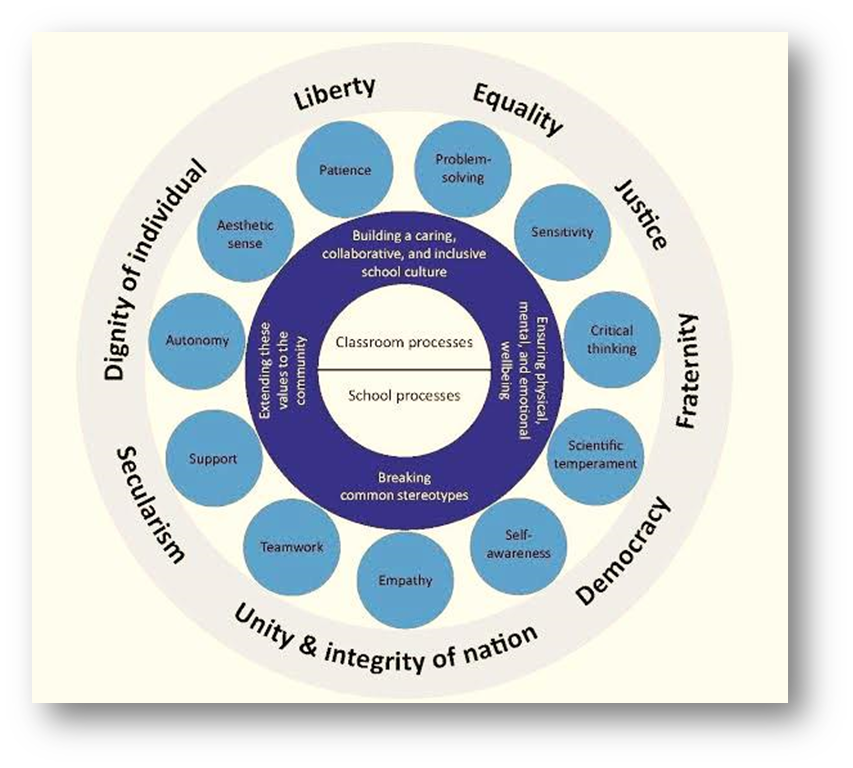
· Nature & Scope of Curriculum
● Nature of Curriculum
A curriculum is a sum of the school subjects and other activities; A mirror which reflects a school's curricular and co-curricular activities; and includes all subjects, which help a child in its cognitive development.
• Curriculum includes many activities such as classroom lesson, cultural activities, laboratory activities, workshop, and sports activities.
• Curriculum is the totality of experiences.
• Curriculum provides experiences to respond, react, and reflect on various processes of learning. It depends on the learner, and as to what he experiences.
• Curriculum is based on intended learning outcome.
• Curriculum, in one sense, is cultural reproduction- Concepts of knowledge and skills such as values, religion, and political system are incorporated in the curriculum, which in turn reflects belief and all cultural aspects.
It is an agenda for social reconstruction- Schools provide an agenda of knowledge, which is curriculum based, and this guides students to enrich society and cultural institutions.
Ø Importance of Curriculum in Schools
Curriculum has a broader meaning, and helps in achieving educational aims and objectives. Curriculum is needed in schools since it contributes in the following ways:
• Gives necessary constructional frame to achieve educational aims. It indirectly shows the specific path to achieve educational aims and gives effective learning to students by providing a variety of learning experiences.
• Curriculum mainly helps in children's all- round development. It builds a balanced personality and helps to use of leisure time constructively.
• Curriculum coordinates the processes of learning-teaching-evaluation.
• It develops creativity and forward outlook
• It contributes to bring equality of education.
Ø WHAT IS THE SCOPE OF CURRICULUM?
The scope of Curriculum studies encompasses the theory, planning, design, development, implementation, and evaluation of Curriculum.
Curriculum Planning: This is concerned with reality-oriented statements like what should be taught? What should be the relationship between the various components of the curriculum? If a society is homogenous, it is easy to answer these questions but if the society is heterogeneous in nature, it may be difficult to answer these complex questions and develop a workable curriculum (emphasis is on content).
Curriculum development involves developing curriculum materials and trying them out by deploying manpower, resources and time. Curriculum development is contextual. That is, it takes place within a larger society and this makes curriculum development become political, economic, social, material, administrative, historical and ideological.
Curriculum Construction: The term "curriculum construction" traditionally refers to all the processes involved in the making of the curriculum. The term is also referred to as "curriculum engineering". Curriculum construction helps in identifying and creating those experiences that will help prepare a student for adult life.
Curriculum Design: This is concerned with the problem of making a choice of how the curriculum should be organized or structured. Various designs or approaches to curriculum can be
• Subject-centered
• Child-centered
• Integrated curriculum
· Core curriculum ( a group of subjects which is made compulsory for all students)
· Emerging needs curriculum
Curriculum Theory: Curriculum theory has its origin in human curiosity, human activity and human problems. Curriculum theory may take the form of a list of the trade; a series of steps on "how to do it", or a set of assertions about what the school is supposed to be doing. Curriculum theorizing is one of the concerns of curriculum studies that is, building theories for curriculum.
-